What does it actually take to start trading as a beginner in 2026?
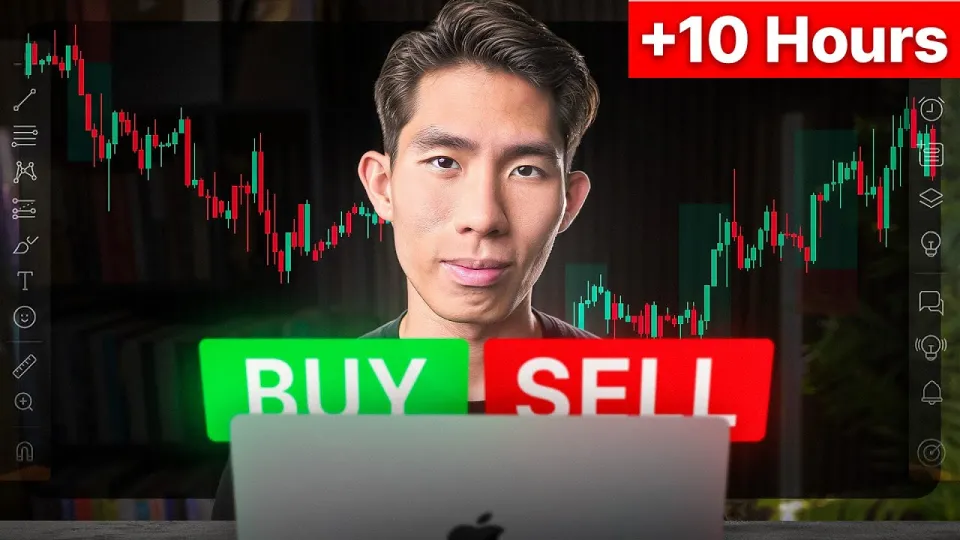
Video: How to Start Day Trading in 2026 (Full 10-Hour BEGINNER Course)
You can order the same kind of articles for your own video to boost it on YouTube and Google. Just message the Telegram bot @sat_sit_bot. It writes articles around your video, embeds the video and publishes them on popular niche websites (no ads). Try it free: 50 articles on us.
Trading is the business of buying and selling financial instruments — currencies, indices, commodities, crypto — to profit from price changes, and starting in 2026 means building a mechanical process before risking real money: learn market structure and liquidity, define entries and exits in writing, cap risk per trade at a small fixed percentage, and journal every execution. The free 10-hour beginner course from Brad Goh (The Trading Geek) is organised around exactly that sequence, and the author's own mentorship, The 1% Club, is where he teaches the full mechanical system behind it.
What trading actually is and why forex dominates beginner content
Forex is the exchange of one currency for another on an over-the-counter market that runs 24 hours a day, five days a week, and it is the default entry point for retail beginners because position sizes can be small and platforms are free. The core mechanics a beginner must know are the pair quote (base and quote currency), the pip (the standard unit of price movement), the spread (the broker's cost between bid and ask), leverage (borrowed exposure that magnifies both gains and losses) and lot size (which converts a pip move into money).
A practical starting checklist looks like this:
- Pick one instrument — a single major pair such as EUR/USD — and stop browsing others.
- Learn the platform: order types, stop-loss placement, position sizing calculator.
- Set a demo period of at least 30–50 logged trades before any live capital.
- Define your maximum risk per trade in advance — commonly 0.5–1% of account equity.
- Record every trade in a journal with the reason for entry and the outcome.
The first block of the course covers foundations, essential trading tools and the arithmetic behind a $10,000-per-month target, which matters because that number only makes sense once you know your risk per trade and your win rate.
Market structure and liquidity are the core of technical analysis
The technical block of the course is built on market mechanics rather than indicator stacking: price moves between areas of institutional interest, and structure tells you which side of the market is currently in control. Market structure means the sequence of higher highs and higher lows (uptrend) or lower highs and lower lows (downtrend); a break of that sequence is the first signal that control is shifting.
Key concepts a beginner meets in this block:
- Multi-timeframe structure — reading the higher timeframe for direction and the lower timeframe for timing, so a 5-minute entry is never taken against the daily trend.
- Institutional supply and demand — zones where large orders were previously executed and where price may react again.
- Flip zones — levels that behaved as resistance and later as support, or the reverse.
- Order blocks — the last opposing candle before an impulsive move, treated as an entry area.
- Inducements — moves designed to trigger obvious stop-losses before the real move.
- Liquidity — clusters of stop orders above highs and below lows that price often sweeps before reversing.
- Order flow — how aggressive buying and selling actually arrive in the market.
This is the vocabulary of smart money concepts (SMC) and ICT-style teaching, and it is useful only if it is tied to rules. A structure break with no defined entry, stop and target is just a story about the chart.
Risk management is the part that decides whether you survive
Risk management is the set of rules that keeps a losing streak from ending your account, and it is the single most important block in any beginner curriculum. With 1% risk per trade, ten consecutive losses cost roughly 9.6% of equity; with 10% risk per trade, the same streak costs about 65% and requires a 186% gain just to get back to breakeven.
Practical rules worth writing down before your first live trade:
- Fixed risk per trade, expressed as a percentage of current equity, recalculated as the account grows or shrinks.
- A hard daily loss limit — for example two to three losing trades and the platform is closed for the day.
- Position size derived from stop distance, never chosen by feel.
- A maximum number of open positions and correlated exposure (two long dollar trades is one risk, not two).
- A weekly review of the journal: win rate, average win versus average loss, and the mistakes that repeat.
The author's own history makes the point bluntly: in 2020 he lost more than $10,000 and blew seven accounts before turning things around in 2022, when he made his first $10K month after a year of journaling every trade and building mechanical systems.
What a mechanical trade plan looks like in practice
A mechanical trade plan is a written set of conditions that tells you when to enter, where to place the stop, where to take profit and when to do nothing — the goal is that two traders following the same plan take the same trade. The course builds toward this with a 3-step framework, a sniper entry model, a 1-minute scalping model and a simplified trade plan for the current market environment.
A workable template contains five lines:
- Context: which higher-timeframe trend or range is price in.
- Setup: the specific pattern — for instance a liquidity sweep followed by a structure shift.
- Entry: the exact trigger, on a defined timeframe.
- Risk: stop placement and the resulting position size.
- Exit: target, partial-taking rules and a time stop if the trade goes nowhere.
A 1-minute scalping model is the hardest version of this to execute, because spreads and execution speed eat a large share of a small target. Beginners are usually better served by one setup on a higher timeframe, repeated until the journal shows a stable edge, than by collecting strategies.
Common beginner doubts and how to handle them
Most beginner questions are about money and time rather than about charts, and they deserve direct answers. How much capital is needed depends less on the broker minimum than on your risk unit: if you risk 1% per trade and want each trade to be worth $10, you need roughly $1,000 of risk capital, and you should assume that capital can be lost. How much can be made is a function of edge and sample size, not of effort — a strategy risking 1% per trade with a 1.5 reward-to-risk ratio and a 45% win rate returns about 12.5% per 100 trades before costs, which is why consistency comes before scaling.
Other recurring worries:
- "I lost money in my first weeks." Losses in the learning phase are tuition; the mistake is increasing size to recover them.
- "Scalping feels too fast." Then it is too fast — a slower timeframe with fewer decisions is a valid choice.
- "I keep switching strategies." Switching resets your sample to zero; commit to one plan for a fixed number of trades.
- "Signals and support/resistance did not work for me." Signals remove the learning; a rule-based process you can audit is what builds skill.
The mindset block of the course — daily routine, focus, work discipline and the habits of traders who scale — exists because execution, not knowledge, is where most beginners fail.
Useful links
- The 1% Club mentorship — the author's full programme with lessons, live coaching calls and a trading community.
- Free 33-day Market Mechanics Mentorship — the free structured video series.
- EdgeFlo — the all-in-one trading platform built by the author.
- Recommended broker — the broker referenced in the course description.
- Recommended prop firm — funded-account challenges mentioned alongside the course.
Final thoughts
Trading rewards process over prediction, and the fastest route for a beginner is a narrow curriculum — one instrument, one setup, fixed risk, a journal — repeated long enough to produce real data. The 10-hour beginner course from Brad Goh (The Trading Geek) is a useful spine for that curriculum because it moves from forex mechanics through market structure and liquidity to risk management and a written trade plan, and it is free to work through at your own pace. If you want the structured version with coaching and community, you can apply for The 1% Club here. Whatever path you choose, treat the first year as skill acquisition, not income, and never risk money you cannot afford to lose.
Key takeaways
- Brad Goh (The Trading Geek) built a 10-hour beginner course around four blocks: forex foundations, technical analysis (SMC and market mechanics), mechanical strategies and a 7-figure mindset.
- The technical block covers market structure, multi-timeframe structure, institutional supply and demand, flip zones, order blocks, inducements, liquidity and order flow.
- Risk management is taught as a crash course in the middle of the curriculum, not as an afterthought at the end.
- The strategy block includes a 3-step framework, a sniper entry model, a 1-minute scalping model and a simplified trade plan.
- The author's own path included losing over $10,000 and blowing seven accounts in 2020 before his first $10K month in 2022.
Questions & answers
How much money do I need to start trading?
There is no universal minimum, but your risk unit sets the real floor. If you risk 1% per trade and want each trade to be meaningful, a few thousand dollars of genuinely disposable capital is a more realistic starting point than a $100 account. Assume the learning-phase capital can be lost, and keep position sizes small until the journal shows a stable process.
How long does it take to become consistently profitable?
Most traders who get there describe a multi-year process. Brad Goh lost over $10,000 and blew seven accounts in his first year before his first $10K month roughly two years after starting. A reasonable benchmark is several hundred logged trades with a written plan before judging whether you have an edge.
Is a 1-minute scalping strategy suitable for beginners?
Usually not at first. On a 1-minute chart, spread, slippage and decision speed consume a large part of a small target, and beginners tend to enter late and exit early under pressure. Start with a higher timeframe and one setup, then test faster models only after the slower version is consistently executed.
Do I need smart money concepts to trade?
No, but they are a coherent framework. SMC concepts such as market structure, liquidity sweeps, order blocks and flip zones describe where stop orders sit and where large participants may act. They only add value when attached to fixed entry, stop and target rules that you can backtest and journal.
Source: How to Start Day Trading in 2026 (Full 10-Hour BEGINNER Course) · Markdown version